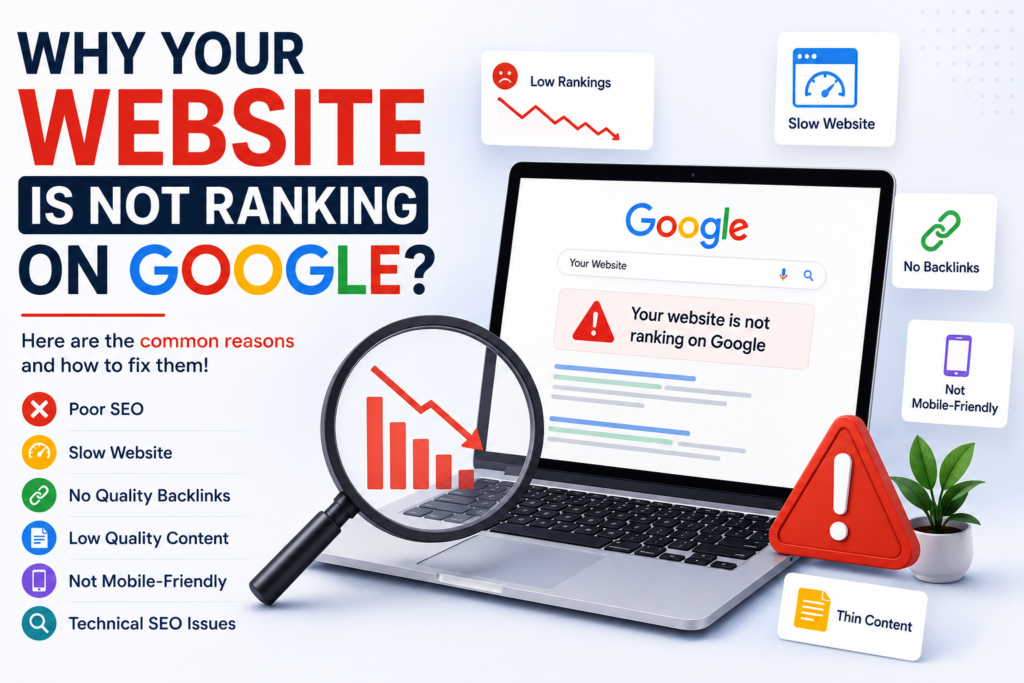
Why Your Website Is Not Ranking on Google?
Introduction Many business owners invest time and money into building a website but still struggle to appear on Google. You may have a professional website, quality products, and good services, yet your website is not generating traffic. If you are wondering why your website is not ranking on Google, you are not alone. Ranking on Google is not an overnight process. Search engines consider hundreds of factors before deciding which websites deserve top positions. The good news is that most ranking issues can be fixed with the right SEO strategy. In this blog, we will discuss the common reasons why your website is not ranking on Google and the solutions you can implement to improve your search engine visibility. Your Website Is New If your website was recently launched, it may take time for Google to trust and rank it. Google needs time to: Discover your website Index your pages Analyse your content Understand your authority Solution Be patient and continue publishing quality content regularly. SEO is a long-term strategy, and results usually take a few months. You Are Targeting Highly Competitive Keywords Many businesses try to rank for broad keywords such as: Digital marketing SEO services Website design These keywords are extremely competitive because established websites already dominate them. Solution Focus on long-tail keywords such as: Affordable SEO services for small businesses Digital marketing agency for startups Local SEO services in India Long-tail keywords are easier to rank for and attract highly targeted traffic. Your Website Is Not Properly Indexed Sometimes Google cannot find your website pages. If your pages are not indexed, they will never appear in search results. Solution Use Google Search Console to: Submit your sitemap Check indexing status Fix crawl errors Request page indexing Regularly monitor your website’s performance. Poor Quality Content Google prioritises useful and valuable content. If your website contains: Thin content Duplicate content Outdated information Keyword stuffing your rankings may suffer. Solution Create original content that solves users’ problems. Your content should: Answer common questions Be easy to understand Provide useful information Be updated regularly Quality content builds authority over time. Your Website Is Too Slow Website speed is an important ranking factor. Visitors do not like waiting for slow websites to load. A slow website can increase bounce rates and negatively impact rankings. Solution Improve website speed by: Compressing images Using a good hosting provider Enabling browser caching Reducing unnecessary plugins Optimising code A faster website provides a better user experience. Your Website Is Not Mobile-Friendly Most internet users browse websites using smartphones. If your website does not work properly on mobile devices, Google may rank it lower. Solution Make sure your website has: Responsive design Readable text Fast mobile loading speed Easy navigation A mobile-friendly website improves both user experience and SEO. You Have Weak On-Page SEO On-page SEO helps search engines understand your content. Without proper optimisation, Google may struggle to identify your page topics. Important On-Page SEO Elements Optimise: Title tags Meta descriptions Headings URL structure Image alt text Internal links Every page should target a specific keyword. You Do Not Have Quality Backlinks Backlinks act as votes of confidence from other websites. If your competitors have stronger backlink profiles, they may rank higher. Solution Build quality backlinks through: Guest blogging Business directories Industry websites Partnerships High-quality content Avoid buying low-quality backlinks because they can harm your website. Technical SEO Problems Are Affecting Your Website Technical SEO issues can prevent Google from crawling and understanding your website. Common technical problems include: Broken links Duplicate pages Missing sitemap Redirect errors Crawl errors Solution Perform regular technical SEO audits and fix any errors immediately. Technical SEO creates a strong foundation for better rankings. Your Website Lacks Internal Linking Internal links help search engines understand the structure of your website. Without internal links, important pages may not receive enough authority. Solution Link related pages together. For example: Link blog articles to service pages Link beginner guides to advanced guides Link relevant topics naturally Good internal linking improves both SEO and user experience. Your User Experience Is Poor Google wants users to have a positive experience when visiting websites. Poor user experience can affect rankings. Signs of Poor User Experience High bounce rate Difficult navigation Too many pop-ups Slow loading pages Confusing design Solution Focus on creating a simple, clean, and user-friendly website. You Are Not Updating Your Website Regularly Search engines prefer active websites. If your website has not been updated for months, Google may consider it less relevant. Solution Publish fresh content consistently. You can create: Blog posts Industry news Case studies Guides FAQs Regular updates signal that your website is active. You Are Ignoring Local SEO If your business serves a local area, local SEO is essential. Without local optimisation, nearby customers may never find your business. Solution Improve local SEO by: Creating a Google Business Profile Using location-based keywords Collecting customer reviews Adding business details to your website Local SEO helps attract nearby customers. How Long Does It Take to Rank on Google? This is one of the most common questions. SEO is a long-term process. Generally, businesses may start seeing results within: 3 to 6 months for low competition keywords 6 to 12 months for medium competition keywords 12 months or more for highly competitive keywords The timeline depends on: Website age Competition level Content quality SEO strategy Domain authority Consistency is the key to success. https://vishu.blog/wp-admin/post.php?post=637&action=edit Conclusion If your website is not ranking on Google, do not panic. Most websites face these challenges in the beginning. The key is to identify the problem and fix it systematically. Focus on creating quality content, improving website speed, optimising SEO, building quality backlinks, and providing an excellent user experience. SEO is not a one-time task. It is an ongoing process that requires patience, consistency, and regular improvements. By implementing these strategies, your website can gradually improve its rankings, attract more visitors, and generate quality leads over time.