
Digital Marketing

Everyone is choosing digital marketing
Digital Marketing

Best Digital Marketing Strategies for Startups

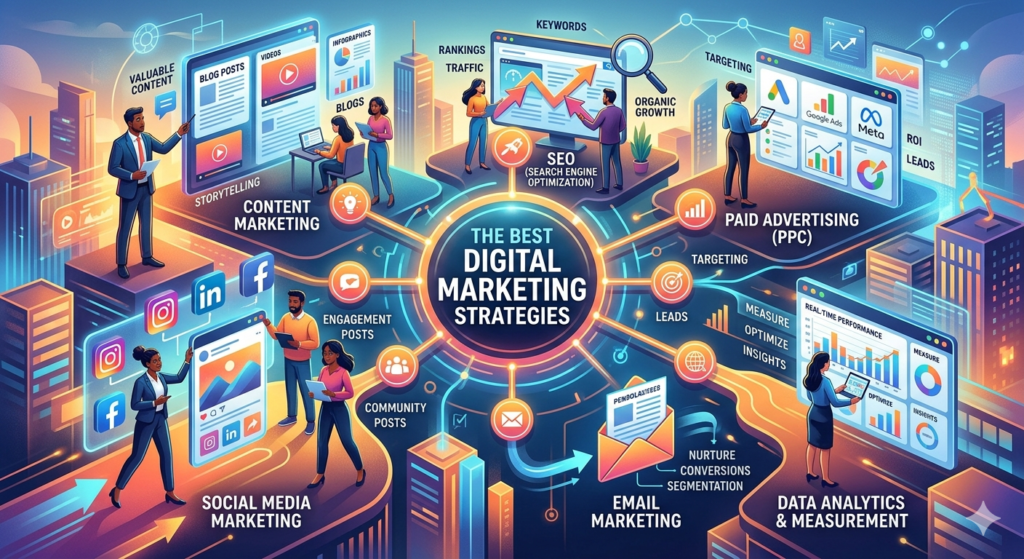
Best Digital Marketing Strategies for Startups. Introduction of Best Digital Marketing Strategies for Startups. Starting a new business is exciting, but attracting customers can be challenging. Many startups have great products and services but struggle to reach their target audience. This is where digital marketing becomes important. Digital marketing helps startups build brand awareness, generate leads, and increase sales without spending huge amounts on traditional advertising. With the right strategy, startups can compete with established businesses and grow their online presence effectively. In 2026, digital marketing continues to evolve with new technologies and customer expectations. Startups that use the latest marketing strategies can gain a competitive advantage and achieve faster growth. In this blog, we will explore the best digital marketing strategies for startups and how they can help businesses succeed in today’s digital world. Build a Strong Website Foundation Your website is the online face of your business. Before investing in marketing campaigns, startups should ensure that their website is professional, fast, and user-friendly. Essential Website Elements Mobile-friendly design Fast loading speed Easy navigation Clear call-to-action buttons Secure HTTPS connection Contact information A well-designed website creates trust and improves conversion rates. It also supports all your digital marketing efforts. Invest in Search Engine Optimisation (SEO) SEO is one of the most cost-effective marketing strategies for startups. By optimising your website for search engines, you can attract organic traffic from people actively searching for your products or services.  Important SEO Activities Keyword research On-page SEO Technical SEO Content optimisation Link building Local SEO Unlike paid advertising, SEO can continue generating traffic and leads for a long time, making it a valuable investment for startups. Create High-Quality Content Content marketing helps startups educate, engage, and attract potential customers. People often search online for answers before making purchase decisions. By creating valuable content, startups can position themselves as industry experts.  Content Types That Work Well Blog posts Case studies Infographics Videos E-books Industry guides Quality content also improves SEO performance and helps generate organic traffic. Focus on Social Media Marketing Social media platforms offer startups an affordable way to reach their audience and build brand awareness. Platforms such as Instagram, Facebook, LinkedIn, and YouTube provide opportunities to engage directly with potential customers.  Social Media Best Practices Post consistently Share valuable content Engage with followers Use relevant hashtags Monitor performance metrics Social media marketing helps startups build trust and develop long-term relationships with customers. Leverage Video Marketing Video content is becoming one of the most powerful marketing tools. Videos are easier to consume and often generate higher engagement compared to text-based content.  Effective Video Ideas Product demonstrations Customer testimonials Educational tutorials Company introductions Behind-the-scenes videos Video marketing can improve brand awareness and increase customer confidence in your business. Use Pay-Per-Click (PPC) Advertising SEO takes time to deliver results, but PPC advertising can generate immediate traffic. Platforms like Google Ads and social media advertising allow startups to target specific audiences based on interests, location, and behaviour.  Benefits of PPC Advertising Instant visibility Targeted audience reach Measurable results Flexible budgets Fast lead generation Startups can use PPC campaigns to test markets and attract customers quickly. Build an Email Marketing Strategy Email marketing remains one of the highest-return digital marketing channels. It allows startups to communicate directly with customers and nurture leads over time.  Email Marketing Benefits Personalised communication Higher customer retention Increased conversions Cost-effective marketing Strong return on investment Building an email list should be a priority for every startup because it provides direct access to potential customers. Optimise for Local SEO For startups serving a specific city or region, local SEO is extremely important. Many consumers search online for nearby businesses before making purchasing decisions. Local SEO Strategies Create a Google Business Profile Collect customer reviews Use local keywords Maintain consistent business information Publish location-specific content Local SEO helps startups attract nearby customers and improve visibility in local search results. Partner with Influencers Influencer marketing is becoming increasingly popular among startups. Collaborating with influencers allows startups to reach established audiences and build trust faster. Why Influencer Marketing Works Increased brand awareness Better audience engagement Higher trust levels Improved conversions Startups can often achieve excellent results by working with micro-influencers who have highly engaged followers.   Use Marketing Automation Tools As startups grow, managing marketing activities manually becomes difficult. Marketing automation tools can help streamline repetitive tasks and improve efficiency. Tasks You Can Automate Email campaigns Social media posting Lead nurturing Customer follow-ups Analytics reporting Automation saves time and allows startup teams to focus on strategic business growth. Focus on Customer Reviews and Testimonials Positive reviews influence customer decisions significantly. Potential customers often check reviews before purchasing products or services.  Benefits of Customer Reviews Build trust Improve credibility Increase conversions Enhance local SEO Encourage satisfied customers to leave reviews on Google and other relevant platforms. Analyse Data and Improve Performance Successful digital marketing relies on continuous improvement. Startups should regularly monitor campaign performance and adjust strategies based on results. Important Metrics to Track Website traffic Conversion rates Bounce rate Cost per lead Return on investment (ROI) Customer acquisition cost Data-driven decisions help startups maximise their marketing budget and achieve better outcomes. Build a Strong Brand Identity A strong brand helps startups stand out in a competitive market. Customers are more likely to trust and remember businesses with a consistent brand image. Key Branding Elements Professional logo Consistent colours Clear messaging Unique value proposition Strong online presence Branding should be integrated into every marketing activity to create a memorable customer experience. Embrace Artificial Intelligence (AI) AI-powered tools are changing digital marketing by improving efficiency and personalisation. AI Applications for Startups Content creation assistance Customer support chatbots Predictive analytics Marketing automation Audience segmentation Startups that adopt AI can save time, reduce costs, and improve marketing performance. Conclusion Digital marketing offers startups an excellent opportunity to compete with larger businesses and reach their target audience effectively. The best digital marketing strategies for startups include SEO, content marketing, social media marketing, video marketing, email marketing, PPC advertising, influencer

Digital Marketing

Digital Marketing with AI in 2026: The Future of Customer Engagement

Introduction The digital marketing landscape has undergone a remarkable transformation over the past decade, and by 2026, Artificial Intelligence (AI) has become the driving force behind nearly every successful marketing strategy. Businesses of all sizes are leveraging AI-powered tools to understand customer behavior, create personalized experiences, automate repetitive tasks, and maximize return on investment (ROI). As consumer expectations continue to evolve, marketers must embrace AI not as a luxury but as a necessity for staying competitive in the digital age. This article explores how AI is reshaping digital marketing in 2026, the key technologies involved, and the opportunities and challenges that come with this revolution. The Rise of AI-Powered Marketing Artificial Intelligence refers to computer systems capable of performing tasks that typically require human intelligence, such as learning, decision-making, problem-solving, and language understanding. In digital marketing, AI analyzes vast amounts of data to identify patterns, predict customer behavior, and automate processes. By 2026, AI is no longer limited to large enterprises. Affordable cloud-based solutions and user-friendly platforms have made advanced marketing technologies accessible to small and medium-sized businesses as well. Companies now use AI to: These capabilities enable businesses to make data-driven decisions faster and more accurately than ever before. Hyper-Personalization: The New Marketing Standard One of the most significant impacts of AI in 2026 is hyper-personalization. Consumers expect brands to understand their preferences, behaviors, and needs. Generic marketing messages are increasingly ineffective. AI-powered systems analyze customer interactions across websites, social media, emails, and mobile applications to create detailed customer profiles. Based on these insights, marketers can deliver highly personalized content, product recommendations, and offers. For example, an e-commerce website can now display unique product suggestions for each visitor based on browsing history, purchase patterns, location, and even current interests. This level of personalization significantly improves customer satisfaction and conversion rates. As a result, businesses that effectively implement AI-driven personalization gain a substantial competitive advantage. AI-Generated Content and Creative Automation Content remains a cornerstone of digital marketing, but AI has transformed how content is created. In 2026, advanced generative AI tools assist marketers in producing blog posts, social media captions, email campaigns, video scripts, and advertising copy within minutes. These tools not only generate content but also optimize it for specific audiences, platforms, and search engines. Marketers can quickly create multiple variations of a campaign and test which version performs best. Video marketing has also benefited from AI. Businesses can now generate professional-quality videos using AI-powered editing tools, voice synthesis, and automated animation software. This reduces production costs and allows brands to scale content creation efficiently. While human creativity remains essential for strategy and storytelling, AI significantly enhances productivity and speeds up execution. Smarter Search Engine Optimization (SEO) Search engine optimization continues to evolve as search engines become more intelligent. In 2026, AI plays a crucial role in SEO strategy and execution. AI-powered SEO tools can: Search engines increasingly prioritize user experience, relevance, and intent rather than simple keyword matching. AI helps marketers understand what users are truly searching for and create content that satisfies those needs. Voice search and conversational search have also become more prominent, requiring marketers to optimize content for natural language queries. AI tools assist businesses in adapting to these changing search behaviors. Predictive Analytics and Data-Driven Decisions One of AI’s most valuable contributions to digital marketing is predictive analytics. Instead of relying solely on historical data, marketers can now forecast future customer actions and market trends. AI algorithms analyze millions of data points to predict: These predictions allow businesses to proactively adjust their strategies and allocate resources more effectively. For example, an online retailer can identify customers likely to abandon their shopping carts and automatically send personalized incentives to encourage purchases. Such proactive marketing efforts improve customer retention and revenue generation. AI-Powered Advertising Digital advertising has become increasingly sophisticated due to AI-driven optimization. Platforms automatically analyze audience behavior, demographics, interests, and engagement patterns to deliver highly targeted advertisements. In 2026, AI helps marketers: Real-time adjustments ensure advertising budgets are spent efficiently. AI continuously learns from campaign performance and makes improvements without requiring constant manual intervention. This automation allows marketing teams to focus more on strategy and innovation while AI handles operational complexities. Conversational Marketing and AI Chatbots Customer engagement has reached new levels through AI-powered chatbots and virtual assistants. Modern chatbots are capable of understanding context, emotions, and complex customer inquiries. Businesses use AI chatbots to: These systems offer immediate responses, reducing wait times and improving customer satisfaction. Advanced conversational AI can even personalize interactions based on previous customer engagements. As natural language processing technology continues to improve, the line between human and AI interactions becomes increasingly difficult to distinguish. Challenges and Ethical Considerations Despite its many advantages, AI-powered marketing also presents challenges. Data privacy remains a major concern as companies collect and analyze large volumes of customer information. Regulatory frameworks around data protection continue to evolve, requiring businesses to maintain transparency and secure customer consent. Ethical AI usage has become an important component of brand trust. Other challenges include: Successful organizations balance automation with human judgment to ensure ethical and responsible marketing practices. The Future of Digital Marketing Looking ahead, AI will become even more integrated into digital marketing strategies. Emerging technologies such as augmented reality (AR), virtual reality (VR), predictive customer journeys, and autonomous marketing systems will further transform how brands connect with consumers. Marketers of the future will need a combination of creativity, analytical thinking, and technological expertise. Rather than replacing marketers, AI will serve as a powerful partner that enhances decision-making and operational efficiency. Organizations that invest in AI skills, tools, and ethical implementation today will be better positioned to thrive in the increasingly competitive digital marketplace. Conclusion Digital marketing in 2026 is defined by intelligence, personalization, and automation. AI empowers businesses to understand customers more deeply, create meaningful experiences, optimize campaigns, and achieve measurable results at scale. From content creation and SEO to predictive analytics and customer engagement, AI has become an essential component of modern marketing success. While

Scroll to Top